
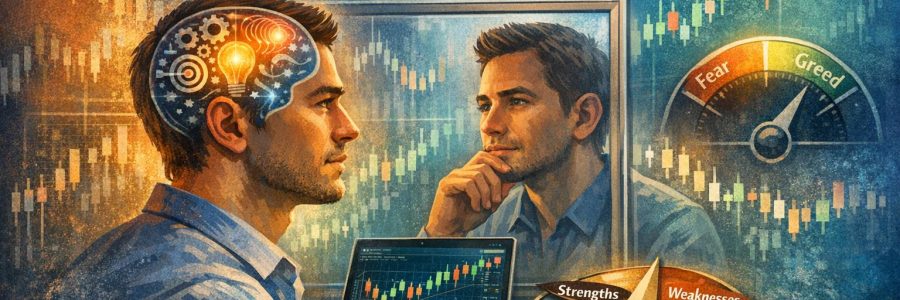
The Role of Self-Awareness in Becoming a Better Trader
The Importance of Self-Awareness in Trading
In the dynamic world of trading, success often depends on more than analytical skill or access to advanced technology. Markets move rapidly, information flows continuously, and uncertainty is a constant factor. Within this environment, a trader’s internal landscape—thought patterns, emotional responses, behavioral habits, and personal expectations—can influence results as much as any external variable. Self-awareness provides the foundation for understanding and managing these internal factors.
Self-awareness in trading refers to the ability to recognize one’s thoughts, emotions, biases, strengths, limitations, and behavioral tendencies in real time. It also involves understanding how these internal elements affect decision-making under pressure. This awareness allows traders to create structures and routines that minimize avoidable errors while reinforcing effective behaviors. Without such awareness, even a technically sound strategy may falter due to inconsistent execution.
Trading performance emerges from the interaction between strategy and execution. While strategies can be backtested and optimized, execution depends largely on the trader’s psychological stability and self-understanding. A clear comprehension of one’s internal patterns enables more consistent implementation of trading rules and more rational responses to market fluctuations.
Understanding Personal Biases
Every trader enters the market with pre-existing beliefs shaped by education, experience, media exposure, and past successes or failures. These beliefs influence how information is interpreted. Cognitive biases are systematic patterns of deviation from rational judgment, and they affect decisions across all domains of human activity. In trading, they can significantly distort risk assessment and evaluation of evidence.
Confirmation bias is among the most common. Traders experiencing this bias may search selectively for data that validates an existing position while discounting contradictory information. For instance, after entering a long position, a trader might focus on bullish economic indicators and ignore emerging signs of weakness. Self-awareness allows the trader to recognize this narrowing of perspective and deliberately seek disconfirming evidence.
Another frequent bias is overconfidence. Past winning trades can lead to an inflated sense of predictive ability. Overconfidence often results in larger position sizes, reduced adherence to stop-loss rules, and insufficient preparation for adverse scenarios. Through self-observation, traders can identify when confidence shifts into unwarranted certainty. Keeping detailed performance records and reviewing statistical results helps anchor perception to objective data rather than selective memory.
Loss aversion also influences trading decisions. Many traders experience greater discomfort from losses than satisfaction from equivalent gains. This can lead to holding losing positions too long in the hope of recovery while prematurely closing winning trades. Recognizing this pattern requires deliberate reflection. By examining trade logs and identifying recurring behaviors, traders can see whether emotional discomfort is shaping decisions more than predefined rules.
Self-awareness does not eliminate biases entirely, but it enables the creation of safeguards. Structured decision-making processes, predefined entry and exit criteria, and routine post-trade analysis reduce the degree to which biases influence real-time choices. The first step in constructing these safeguards is acknowledging that biases are universal and persistent.
Emotional Regulation
Financial markets are environments of uncertainty and risk. Price fluctuations can occur rapidly, exposing traders to potential gains and losses within short time frames. These conditions naturally elicit emotional responses such as excitement, fear, frustration, or impatience. Without emotional regulation, these responses can override rational analysis.
Self-aware traders develop the ability to identify early signs of emotional activation. Physical cues may include a faster heartbeat, muscle tension, changes in breathing, or a sense of urgency. Cognitive cues may involve repetitive thoughts, exaggerated expectations, or impulsive reasoning. Recognizing these signals in their early stages allows traders to pause before acting.
Fear is particularly influential. During periods of heightened volatility, fear can prompt traders to exit positions prematurely or avoid valid setups altogether. Conversely, the fear of missing out may drive impulsive entries without sufficient analysis. Self-awareness helps differentiate between legitimate risk signals—such as a break in market structure—and emotionally driven impulses that lack analytical basis.
Excitement and euphoria following a series of profitable trades can be equally destabilizing. Elevated confidence may lead to deviations from the trading plan, such as increasing leverage beyond acceptable limits. By monitoring emotional states after wins as closely as after losses, traders maintain consistency. Emotional neutrality, rather than emotional suppression, is the goal. The objective is not to eliminate feelings but to prevent them from dictating actions.
Practical techniques support emotional regulation. Some traders employ mindfulness meditation to strengthen attention and awareness of internal states. Others use structured breathing exercises during periods of stress. Maintaining a consistent trading routine, limiting exposure to unnecessary market noise, and predefining risk parameters also reduce emotional intensity. These practices are most effective when built upon a foundation of honest self-assessment.
Adaptability and Continuous Learning
Markets evolve due to economic shifts, regulatory changes, technological innovation, and changes in participant behavior. Strategies that perform well under certain volatility regimes or liquidity conditions may struggle when circumstances change. Adaptability is therefore essential for sustained performance.
Self-aware traders are better positioned to recognize when underperformance results from changing market conditions versus flaws in execution. Without self-awareness, it is easy to attribute negative results solely to external factors. However, a balanced evaluation considers both strategic suitability and personal discipline.
Continuous learning is a natural extension of self-awareness. Traders who understand their knowledge gaps can seek appropriate education, whether through formal study of macroeconomics, deeper engagement with quantitative methods, or refinement of technical analysis skills. They are less likely to rely exclusively on familiar methods if evidence suggests alternative approaches may offer advantages.
Maintaining a learning mindset also reduces defensiveness. When traders view setbacks as information rather than personal failures, adaptation becomes more systematic. Performance reviews, strategy adjustments, and risk recalibration become routine components of professional development rather than reactive measures triggered only by significant drawdowns.
Adaptability does not imply constant strategy changes. Rather, it involves measured evaluation supported by data. Self-aware traders track performance metrics across different market environments, examine drawdown patterns, and test potential improvements before implementation. This deliberate process reduces the likelihood of frequent, emotionally driven changes that undermine consistency.
Developing a Personal Trading Plan
A trading plan translates self-knowledge into structured action. It defines markets traded, time frames, entry and exit criteria, position sizing rules, and risk limits. However, beyond technical specifications, an effective plan reflects the trader’s personality, lifestyle, and cognitive preferences.
For example, some individuals thrive in fast-paced environments and maintain focus during rapid decision-making. Others perform better with longer time horizons that allow extended analysis. Self-awareness clarifies these preferences. A mismatch between personality and trading style often results in stress and inconsistent performance. Day trading may not suit someone who requires extended reflection before making decisions, while long-term position trading may not satisfy someone drawn to frequent engagement.
Risk tolerance is another essential variable shaped by personal circumstances and psychological comfort. Two traders with similar account sizes may perceive identical drawdowns very differently. Accurate self-assessment leads to position sizing aligned with emotional capacity. Excessive risk relative to tolerance compromises discipline and increases the probability of rule violations.
Time availability also plays a role. Traders balancing professional or family commitments must design plans compatible with limited screen time. Attempting strategies that require constant monitoring despite competing responsibilities often leads to missed signals or rushed decisions. Incorporating realistic time constraints into the trading plan enhances reliability.
A written plan serves as an external reference point during periods of stress. When emotions intensify, referring to predefined rules reduces cognitive load. The effectiveness of such a plan depends on its alignment with the trader’s authentic characteristics, which only sustained self-observation can reveal.
Performance Review and Reflective Practice
Ongoing self-awareness requires structured reflection. Maintaining a detailed trading journal is one of the most effective tools. A comprehensive journal documents not only entry and exit prices but also reasoning, emotional state, market context, and adherence to rules. Over time, patterns emerge that may not be visible in isolated trades.
Reviewing this data at regular intervals supports objective evaluation. Statistical analysis highlights tendencies such as consistent underperformance during specific market sessions or systematic rule deviations after large losses. Emotional notes can reveal connections between stress levels and impulsive decisions. This information guides targeted improvements.
Reflection should distinguish between outcome quality and decision quality. A well-executed trade can result in a loss due to market randomness, while a poorly structured trade might yield profit by chance. Self-aware traders evaluate whether their process aligns with their plan, regardless of immediate financial outcome. This process-oriented perspective encourages long-term consistency.
Periodic strategic audits also contribute to growth. These audits assess whether the trading plan remains aligned with evolving goals, financial conditions, and personal development. For example, as capital increases or experience deepens, adjustments to position sizing or diversification may become appropriate. Self-awareness ensures these changes are deliberate rather than reactive.
Risk Management and Psychological Resilience
Risk management is both a technical and psychological discipline. Setting stop-loss levels, controlling leverage, and diversifying across instruments represent technical measures. However, adherence to these measures depends on psychological resilience. When losses occur, the temptation to override risk controls can be strong.
Self-aware traders anticipate emotional reactions to drawdowns and design safeguards accordingly. For example, they may reduce position size after a defined sequence of losses to maintain composure. They may also establish daily or weekly loss limits that automatically halt trading. These mechanisms acknowledge human vulnerability instead of assuming constant rationality.
Resilience involves accepting the probabilistic nature of trading. No strategy yields uninterrupted gains. Understanding this reality reduces the inclination to interpret losses as personal shortcomings. Self-awareness supports a balanced self-concept in which performance is evaluated in terms of process adherence and long-term expectancy rather than isolated results.
Developing resilience also requires realistic expectations. Traders who expect immediate mastery often experience frustration that impairs discipline. Recognizing one’s stage of development enables more accurate goal-setting. Incremental improvement, rather than dramatic short-term success, becomes the benchmark for progress.
The Broader Professional Context
In institutional settings, self-awareness extends beyond individual decision-making to collaboration and communication. Portfolio managers, analysts, and risk officers operate within teams. Awareness of one’s communication style, tolerance for disagreement, and reaction to feedback enhances collective performance.
For independent traders, the broader context may include interaction with online communities, mentors, or service providers. Understanding susceptibility to external influence is part of self-awareness. Traders who easily internalize others’ opinions may need stricter boundaries around information intake to preserve strategic clarity.
Technological tools such as algorithmic systems and automated alerts can also support disciplined execution. However, overreliance on automation without self-understanding can create complacency. Even algorithmic approaches require human oversight, parameter adjustments, and risk evaluation. Self-awareness ensures that technology complements rather than replaces thoughtful judgment.
Conclusion
Self-awareness forms a central pillar of effective trading. By examining personal biases, regulating emotional responses, and aligning strategies with individual characteristics, traders create a stable foundation for consistent execution. It enables structured learning, thoughtful adaptation to changing market conditions, and disciplined risk management.
Trading will always involve uncertainty and fluctuating outcomes. Analytical tools and strategic frameworks are essential, yet they function optimally only when paired with a clear understanding of the individual applying them. Through continuous reflection, performance review, and honest self-assessment, traders strengthen their capacity for objective decision-making. This integration of technical competence and psychological insight supports sustainable development and long-term participation in financial markets.
This article was last updated on: April 19, 2026