
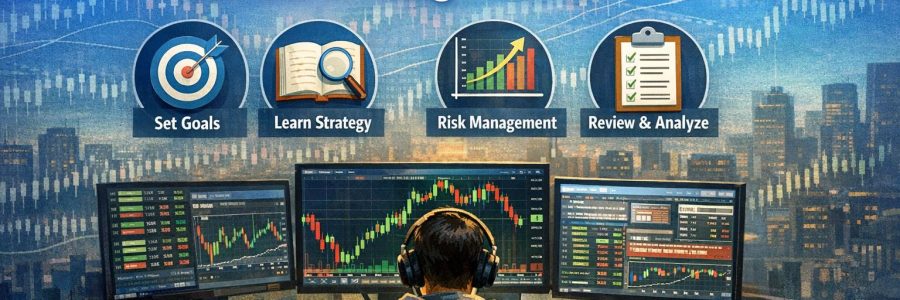
What to Focus on in Your First Year of Serious Trading Practice
Establishing a Strong Foundation in Trading
Embarking on your first year of serious trading practice represents a structured transition from casual interest to disciplined participation in financial markets. This initial year is less about achieving high returns and more about building competencies that can support long-term consistency. The foundation formed during this period influences how you analyze opportunities, manage uncertainty, respond to setbacks, and refine your decision-making processes.
Trading is often perceived as a fast-paced activity focused on short-term gain. In practice, however, sustainable progress requires deliberate preparation. The first year should be treated as a period of professional development. It involves cultivating analytical ability, developing a repeatable methodology, learning how to manage risk, and understanding your own behavioral tendencies under financial pressure. A clear structure and measurable goals provide stability during a stage that can otherwise feel overwhelming.
Focus on Education and Research
Education forms the structural base of productive trading. Without a working understanding of how markets operate, it is difficult to make informed decisions. At a minimum, beginners must understand order types, market structure, liquidity, volatility, and the mechanics of pricing. Learning the distinctions between market orders, limit orders, and stop orders provides insight into how trades are executed and how quickly positions can change.
Beyond mechanical knowledge, traders benefit from exploring both technical analysis and fundamental analysis. Technical analysis examines price patterns, trends, and statistical indicators derived from historical data. Fundamental analysis evaluates broader economic factors, corporate performance metrics, and macroeconomic developments. Even if you ultimately prefer one approach, familiarity with both expands your interpretive framework.
Structured study can include reading textbooks on market theory, reviewing academic research on behavioral finance, and observing how experienced traders interpret charts and financial statements. However, consuming information without application can create a false sense of confidence. Each concept should be tested and evaluated within a controlled environment. This transforms theoretical knowledge into practical skill.
Independent research also plays an important role. Financial markets are influenced by central bank policy decisions, geopolitical developments, earnings announcements, and economic data releases. Developing the habit of reviewing credible financial reports and analyzing how markets respond to news events builds contextual awareness. Over time, this awareness becomes a vital part of assessing potential opportunities and risks.
Choose the Right Trading Instruments
Selecting appropriate trading instruments is a strategic decision that influences learning pace and exposure to risk. Stocks, foreign exchange, futures, options, and exchange-traded funds each possess distinct characteristics related to leverage, volatility, margin requirements, and trading hours.
For instance, stock markets typically operate during set hours and may be suitable for individuals who prefer defined schedules. Foreign exchange markets operate continuously during the business week, allowing flexibility but requiring disciplined monitoring. Futures and options offer higher leverage, which can amplify both gains and losses, demanding advanced risk control.
In the first year, limiting your focus to one or two instruments supports deeper learning. Attempting to trade multiple markets simultaneously may dilute attention and complicate performance analysis. By specializing initially, you can study recurring behaviors unique to that instrument, such as how a currency pair reacts to interest rate announcements or how a particular stock responds to earnings reports.
Instrument selection should also align with personal risk tolerance and time availability. Traders with limited daily time may prefer swing trading strategies on longer time frames, while those able to monitor markets intraday might explore shorter-term approaches. Clarity regarding these logistical considerations reduces unnecessary stress and increases consistency.
Understanding Market Conditions
Different markets rotate between trending, ranging, and volatile states. Recognizing these shifts is an essential part of foundational training. Strategies that perform well during trending conditions may fail in consolidating markets. A structured review of historical charts helps build the ability to distinguish between these states.
During the first year, traders should avoid constant strategy switching in response to temporary market changes. Instead, focus on understanding how one chosen strategy behaves under different conditions. Documenting performance metrics such as win rate, average reward-to-risk ratio, and maximum drawdown helps quantify results rather than relying on subjective impressions.
Risk Management Skills
No aspect of trading is more important than risk management. Even effective analytical skills cannot compensate for poor risk control. The primary objective in the early stages should be capital preservation. Maintaining sufficient capital allows continued learning and adaptation.
Position sizing is the central element of risk management. Determining what percentage of total capital to risk on a single trade prevents isolated losses from causing disproportionate damage. Many beginning traders adopt a rule of risking only a small percentage of account equity per trade. While exact percentages vary according to strategy and risk tolerance, the underlying principle is consistent: preserve longevity.
Stop-loss placement must be based on logical market structure rather than arbitrary levels. Stops placed too tightly may result in frequent premature exits, while stops placed too loosely can increase drawdown. Through consistent documentation, traders learn how different stop placements affect outcomes.
Risk-reward analysis is another foundational practice. Before entering any trade, evaluating the potential upside relative to the defined downside clarifies whether the opportunity aligns with overall objectives. Over time, understanding this balance fosters selectivity and reduces impulsive participation.
Building a Trading Plan
A trading plan translates theory into structured action. It should include clearly defined criteria for trade selection, position sizing rules, acceptable trading hours, and procedures for reviewing results. The plan acts as a reference point during moments of uncertainty.
An effective plan does not attempt to predict every possible market outcome. Rather, it establishes rules that guide behavior under varying conditions. For example, it may define precise chart patterns required for entry or specify economic announcements during which trading will be avoided. Consistent adherence allows performance to be evaluated objectively.
Periodic review of the trading plan is necessary, particularly after accumulating sufficient data. Adjustments should be evidence-based rather than driven by frustration or excitement. Changes grounded in recorded performance metrics reduce the likelihood of inconsistency.
Record Keeping and Review
A comprehensive trading journal transforms isolated trades into structured data. Each entry should include the date, instrument, setup rationale, entry price, exit price, position size, stop placement, and outcome. Adding contextual information, such as prevailing market conditions or relevant news catalysts, further strengthens analysis.
Over weeks and months, patterns emerge. You may identify that certain setups consistently outperform others or that trading during specific time periods produces lower efficiency. This accumulation of data allows refinement of strategy and elimination of weaker behaviors.
Review sessions should occur at predetermined intervals, such as weekly or monthly. During these sessions, calculate performance metrics, assess adherence to the trading plan, and identify deviations. The objective is not self-criticism but process improvement. By focusing on measurable variables, review becomes constructive rather than reactive.
Maintaining organized records also reinforces accountability. When every trade is documented, impulsive actions become more visible. This transparency promotes disciplined behavior and supports long-term development.
Developing Emotional Discipline
Emotional regulation plays a fundamental role in trading consistency. Market fluctuations can trigger fear during drawdowns and overconfidence after gains. Both reactions can distort decision-making.
Developing emotional discipline begins with awareness. Recognizing how your body and thoughts respond to gains and losses allows early intervention. Structured routines, such as reviewing your trading plan before the market opens, reduce spontaneous decisions.
Predefined rules limit the influence of momentary impulses. When entry and exit criteria are fixed in advance, there is less room for hesitation or second-guessing. Some traders implement daily loss limits, after which trading stops for the day. This protects against revenge trading and emotional escalation.
Incorporating objective self-assessment into journal reviews further strengthens discipline. Instead of evaluating yourself solely on profit outcomes, evaluate adherence to process. A well-executed losing trade aligned with the plan is more constructive than a profitable trade entered impulsively.
Practicing with Simulated Trading
Simulated trading provides a structured training environment without financial exposure. Demo accounts replicate real-time price data and order execution, enabling practice of strategy implementation, order management, and platform navigation.
However, simulation should not become indefinite avoidance of real market exposure. While it allows experimentation, emotional intensity is reduced because no capital is at risk. At some point, gradual transition to small real positions introduces psychological variables that cannot be replicated in simulation.
A defined progression plan can be useful. For example, begin with simulated trading until consistent metrics are demonstrated over a predetermined sample size. Then move to minimal real position sizes while continuing to track performance. Gradual scaling ensures that risk increases proportionally with skill development.
Understanding Performance Metrics
Quantitative evaluation provides objectivity. Key metrics include win rate, average gain versus average loss, maximum drawdown, and expectancy. Expectancy represents the average outcome per trade, calculated by combining probability of winning with reward-to-risk ratio. Positive expectancy indicates that, over a large series of trades, the approach has statistical viability.
Understanding these metrics shifts focus away from short-term fluctuations. Individual trades become part of a probability distribution rather than singular verdicts on ability. This perspective supports patience and discourages overreaction to isolated setbacks.
Adopting a Long-Term Perspective
The first year should emphasize process over profit. While achieving returns is desirable, prioritizing disciplined execution establishes habits that support sustainability. Viewing each month as a data collection phase rather than a success-or-failure test fosters continuous improvement.
Markets evolve, and adaptability becomes increasingly important. However, adaptation is most effective when grounded in structured review rather than emotional reaction. By the end of the first year, a trader who has maintained consistent records, respected risk parameters, and refined a coherent strategy possesses a functional framework for continued development.
Patience is a practical requirement. Skill acquisition in trading resembles skill acquisition in other performance-based fields. Repetition, evaluation, and incremental improvement lead to compounding competence. Accepting gradual progression reduces pressure and allows deeper concentration on method refinement.
Conclusion
Establishing a strong trading foundation requires coordinated development across multiple domains: education, instrument selection, risk management, planning, documentation, emotional discipline, and practical application through simulation and measured live trading. Each component reinforces the others. Education informs strategy design; strategy design shapes risk management; risk management preserves capital for continued learning; documentation enables refinement.
By focusing on structured growth during the first year, traders create an environment where improvement is systematic rather than accidental. The objective is to build reproducible processes that withstand varying market conditions. With careful attention to these fundamentals, a new trader moves beyond experimentation toward disciplined participation in a complex and evolving market environment.
This article was last updated on: May 3, 2026