
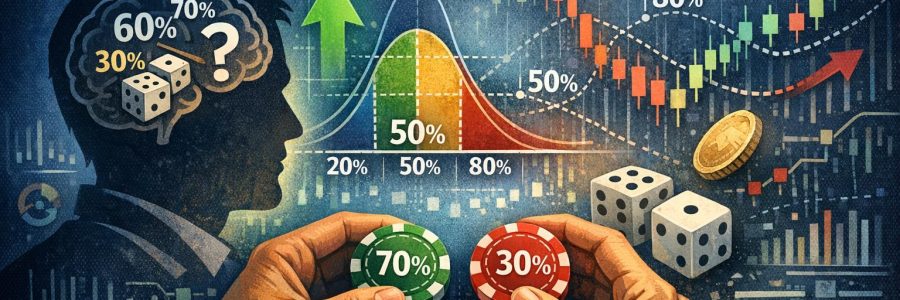
What It Really Means to Think in Probabilities as a Trader
Understanding Probabilistic Thinking in Trading
In financial markets, outcomes are never guaranteed. Prices fluctuate due to a wide range of influences, including economic data, geopolitical developments, liquidity conditions, institutional positioning, and behavioral factors. Within this environment, traders must operate without certainty. Probabilistic thinking provides a structured way to approach this uncertainty. Rather than attempting to predict exact outcomes, traders evaluate the relative likelihood of different scenarios and align their decisions accordingly.
At its foundation, probabilistic thinking means assessing trades in terms of potential distributions of outcomes. A trader does not ask, “Will this trade win?” but instead considers, “Given my strategy, what is the probability of success, and how does the expected reward compare to the potential loss?” This perspective shifts the focus from single trade results to the performance of a method across a series of trades. Over time, consistency in applying a strategy with positive expectancy can generate favorable results, even if individual trades produce losses.
The transition from certainty-based thinking to probability-based thinking is often challenging. Many new traders search for perfect indicators or definitive signals that eliminate ambiguity. However, markets do not operate in deterministic patterns. Accepting the probabilistic nature of trading is a foundational step toward building a sustainable methodology.
Embracing Uncertainty
Uncertainty in financial markets arises from the complexity of interactions among participants. Every transaction reflects differing motivations, time horizons, capital allocations, and access to information. Even when market data appears clear, the interpretation of that data varies. As a result, no analytical tool can eliminate risk entirely.
Embracing uncertainty means recognizing that losses are not necessarily evidence of flawed thinking. A trade can follow all established rules and still produce a negative outcome. In probabilistic terms, this represents variance rather than failure. Professional traders understand that variance is inherent in any statistical edge. The key distinction lies between random loss and structural weakness in a strategy.
By accepting uncertainty, traders shift their focus toward process quality. They evaluate whether each trade adheres to predefined rules rather than judging decisions solely by profit or loss. This process-oriented mindset reduces impulsive behavior and supports long-term discipline. It also prevents overconfidence after winning streaks and discouragement after losing periods.
Uncertainty also reinforces the importance of flexibility. Market regimes change over time. Volatility environments shift, correlations evolve, and liquidity conditions differ across cycles. Strategies that perform well in trending markets may struggle in range-bound conditions. Probabilistic thinkers acknowledge these shifts and adapt their expectations accordingly, understanding that probabilities are conditional rather than fixed constants.
The Role of Probabilistic Models
Probabilistic models translate historical data into structured forecasts about potential future movements. These models range from simple statistical calculations to advanced quantitative systems involving regression analysis, time-series modeling, and machine learning algorithms. Regardless of complexity, the purpose remains consistent: to estimate the likelihood of different outcomes based on identifiable patterns.
Historical price behavior provides a starting point. Traders examine past instances of similar market conditions to evaluate how prices reacted. For example, a trader might study how a currency pair behaves following a breakout from a prolonged consolidation. By measuring the frequency of continuation versus reversal, the trader can estimate probabilities for future occurrences under similar circumstances.
However, it is important to recognize that historical probabilities are conditional estimates, not guarantees. Markets evolve, and structural factors can alter their behavior. Therefore, models must be reviewed and recalibrated periodically. Overfitting to historical data—designing a model that performs exceptionally well on past data but poorly in live environments—is a common risk. Effective probabilistic modeling balances historical insight with robustness against future variability.
In discretionary trading, probabilistic thinking may not rely on formal statistical formulas but instead on structured observation. Experienced traders develop a sense of probability through repeated exposure to patterns. Even in these cases, maintaining written records and analyzing performance data transforms intuition into measurable probabilities.
Some traders integrate scenario analysis into their modeling. Instead of relying on a single forecast, they outline multiple potential developments, assigning probabilities to each. This approach improves preparation and reduces surprise, as the trader is mentally prepared for alternative outcomes.
Risk Management and Probabilities
Risk management reflects the practical application of probabilistic thinking. Even if a strategy offers a statistical edge, inappropriate position sizing or inadequate loss control can undermine long-term performance. The alignment of probability and risk management determines sustainability.
The concept of expected value plays a central role. Expected value calculates the average outcome of a trade, considering both the probability of success and the magnitude of gains and losses. For example, a strategy that wins 40 percent of the time may still be profitable if its winning trades significantly exceed its losses. Conversely, a strategy with a high win rate may be unprofitable if losses are disproportionately large.
Risk-reward ratios must be interpreted alongside probability assessments. A favorable ratio is not meaningful unless it aligns with the strategy’s win rate. Traders who understand this relationship avoid unrealistic expectations and focus on strategies that maintain positive expectancy across numerous executions.
Position sizing is another critical factor. Even high-probability setups carry risk. Allocating excessive capital to a single trade increases the likelihood of severe drawdowns. Many traders use fixed percentage models, risking only a small proportion of total capital on each trade. This approach ensures that a sequence of losses does not significantly impair overall capital.
Stop-loss orders serve as predefined exit mechanisms that limit downside exposure. From a probabilistic perspective, stop-loss placement reflects the boundary at which the underlying trade premise is invalidated. Rather than reacting emotionally to adverse movements, the trader adheres to predetermined thresholds that reflect calculated risk tolerance.
Diversification can also enhance probabilistic stability. By distributing exposure across different instruments or strategies, traders reduce dependence on a single outcome stream. While diversification does not eliminate risk, it can smooth equity curves by minimizing correlation among positions.
Critical Thinking and Continuous Learning
Probabilistic thinking requires ongoing evaluation. Financial markets are adaptive systems influenced by technological innovation, regulatory changes, and macroeconomic shifts. As conditions evolve, historical probabilities may weaken or shift. Traders who rely solely on past assumptions risk applying outdated models to new environments.
Continuous learning involves systematic performance review. Traders maintain detailed journals documenting entry conditions, exit decisions, position sizes, and contextual factors. By analyzing these records, patterns of strength and weakness emerge. Statistical review transforms subjective impressions into measurable performance indicators.
Critical thinking also demands skepticism toward apparent certainty. Market narratives often frame events as predictable in hindsight. However, probabilistic thinkers recognize that outcomes are influenced by numerous interacting variables. They avoid attributing success solely to skill or failure solely to bad luck without reviewing data.
Incorporating scenario planning enhances adaptive capability. Traders may analyze how their strategies perform under varying volatility conditions or during economic announcements. This analysis refines conditional probabilities and prepares strategies for range expansion or contraction phases.
Technological advancements support continuous learning. Trading platforms provide data analytics, backtesting tools, and simulation environments. When used properly, these tools allow traders to test hypotheses before committing capital. However, traders must remain cautious about data bias and unrealistic assumptions in simulations.
A growth-oriented mindset complements probabilistic reasoning. Instead of attempting to eliminate uncertainty, traders refine how they respond to it. They develop resilience by understanding that statistical edges manifest over sequences, not individual trades.
Psychological Dimensions of Probabilistic Thinking
Although probabilistic thinking is grounded in statistics, its effectiveness depends heavily on psychological factors. Cognitive biases can distort risk perception and interfere with rational judgment. Confirmation bias, for instance, may lead a trader to prioritize information that supports a desired outcome while overlooking contradictory evidence.
Loss aversion represents another common challenge. Research in behavioral finance suggests that losses often exert a stronger psychological impact than equivalent gains. As a result, traders may close profitable trades prematurely while allowing losing trades to extend beyond planned limits. Probabilistic discipline requires consistent rule enforcement despite emotional impulses.
Overconfidence can also erode probabilistic balance. After a series of successful trades, some traders increase position sizes excessively or deviate from their tested strategy. This behavior ignores the possibility of regression toward average performance. Maintaining stable risk parameters reflects acknowledgment that probability distributions remain constant over time.
Developing psychological resilience involves structured routines. Pre-trade planning, post-trade evaluation, and predefined decision frameworks reduce impulsive reactions. By grounding decisions in data rather than immediate emotion, traders strengthen alignment with probabilistic principles.
Long-Term Application of Probability in Trading
The true value of probabilistic thinking emerges over extended horizons. Single trades provide limited information. A substantial sample size reveals whether a strategy possesses consistent edge. Statistical significance increases as data accumulates, allowing traders to measure performance drift and variance patterns.
Equity curve analysis offers insight into probability distribution. Drawdowns are inevitable, even for profitable systems. Assessing maximum historical drawdowns helps traders determine whether current performance falls within expected bounds. If losses exceed historical variance, further investigation may be necessary to determine whether structural change has occurred.
Compounding capital magnifies the importance of disciplined probability application. Consistent modest returns, managed within strict risk parameters, can accumulate significantly over time. This process reflects adherence to strategic consistency rather than reliance on infrequent high-risk trades.
Institutional trading desks often formalize probabilistic processes through risk committees and quantitative review frameworks. While individual traders may not possess similar infrastructure, they can replicate aspects through structured analytics and disciplined recordkeeping. The principle remains the same: every trade represents one probabilistic event within a broader distribution.
Integrating Probability with Strategic Planning
Strategic planning in trading involves defining objectives, acceptable risk thresholds, and time horizons. Probability informs each of these elements. A short-term trader operating on intraday timeframes encounters different probability distributions than a long-term investor evaluating quarterly data. Adjusting models to align with chosen timeframes enhances coherence between expectation and execution.
Market selection also reflects probabilistic evaluation. Certain instruments exhibit higher volatility or lower liquidity, altering probability distributions. Traders assess whether their strategy aligns with these characteristics. For example, mean-reversion strategies may perform differently in stable currency markets compared to highly volatile commodities.
Execution quality influences realized probability outcomes. Slippage, transaction costs, and liquidity constraints reduce net expectancy. Incorporating these elements into probabilistic calculations produces more realistic performance projections. Ignoring them can create inflated expectations inconsistent with live results.
Periodic strategy audits help maintain alignment between probabilistic assumptions and actual performance. During these reviews, traders evaluate win rates, average risk-reward ratios, volatility exposure, and correlation patterns. Adjustments are made cautiously, preserving core statistical properties while improving robustness.
Conclusion
Probabilistic thinking forms the intellectual foundation of sustainable trading practice. By focusing on likelihoods rather than certainties, traders develop structured approaches to risk, expectation, and performance evaluation. Embracing uncertainty allows them to view losses as components of variance rather than personal failures. Through probabilistic models, disciplined risk management, continuous learning, and psychological stability, traders build frameworks that withstand changing market conditions.
Ultimately, trading success is not derived from predicting outcomes with precision but from consistently applying strategies with positive expectancy across numerous instances. The integration of probability into decision-making provides clarity in uncertain environments and supports rational, process-driven participation in financial markets.
This article was last updated on: March 3, 2026